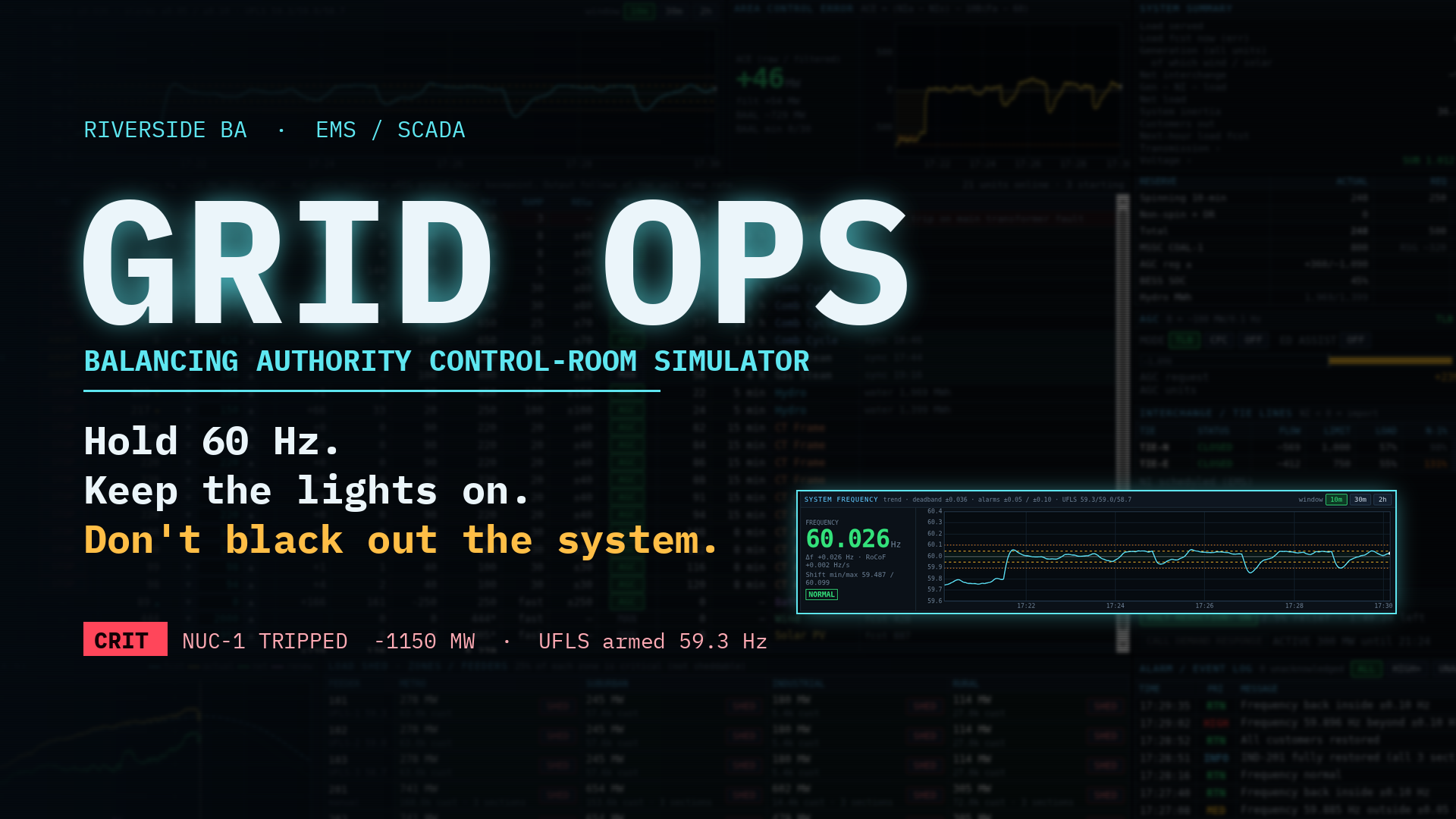
Grid Ops
GRID OPS: Balancing Authority Control-Room Simulator
Hold 60 Hz. Keep the lights on. Don't black out the system.
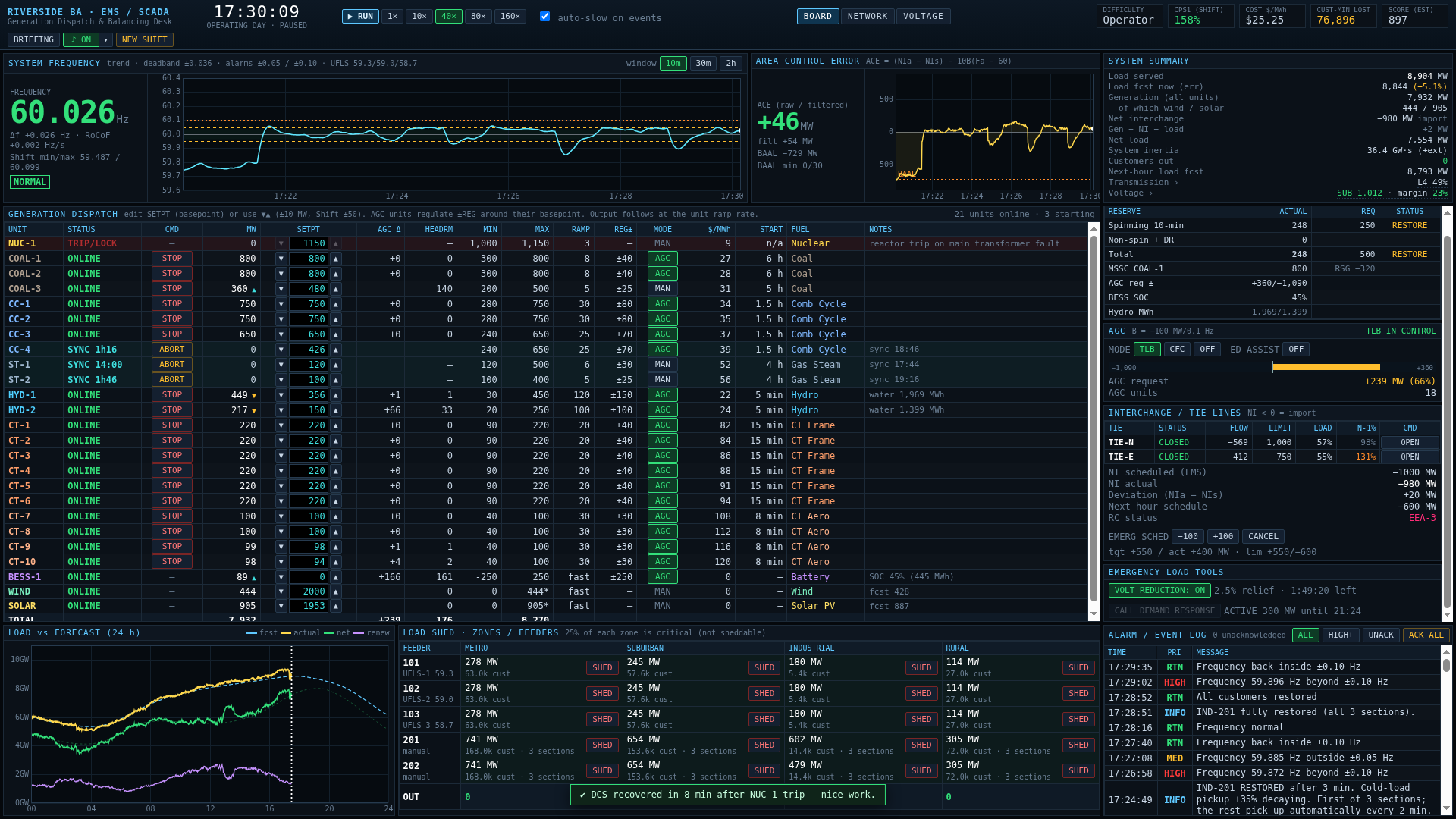
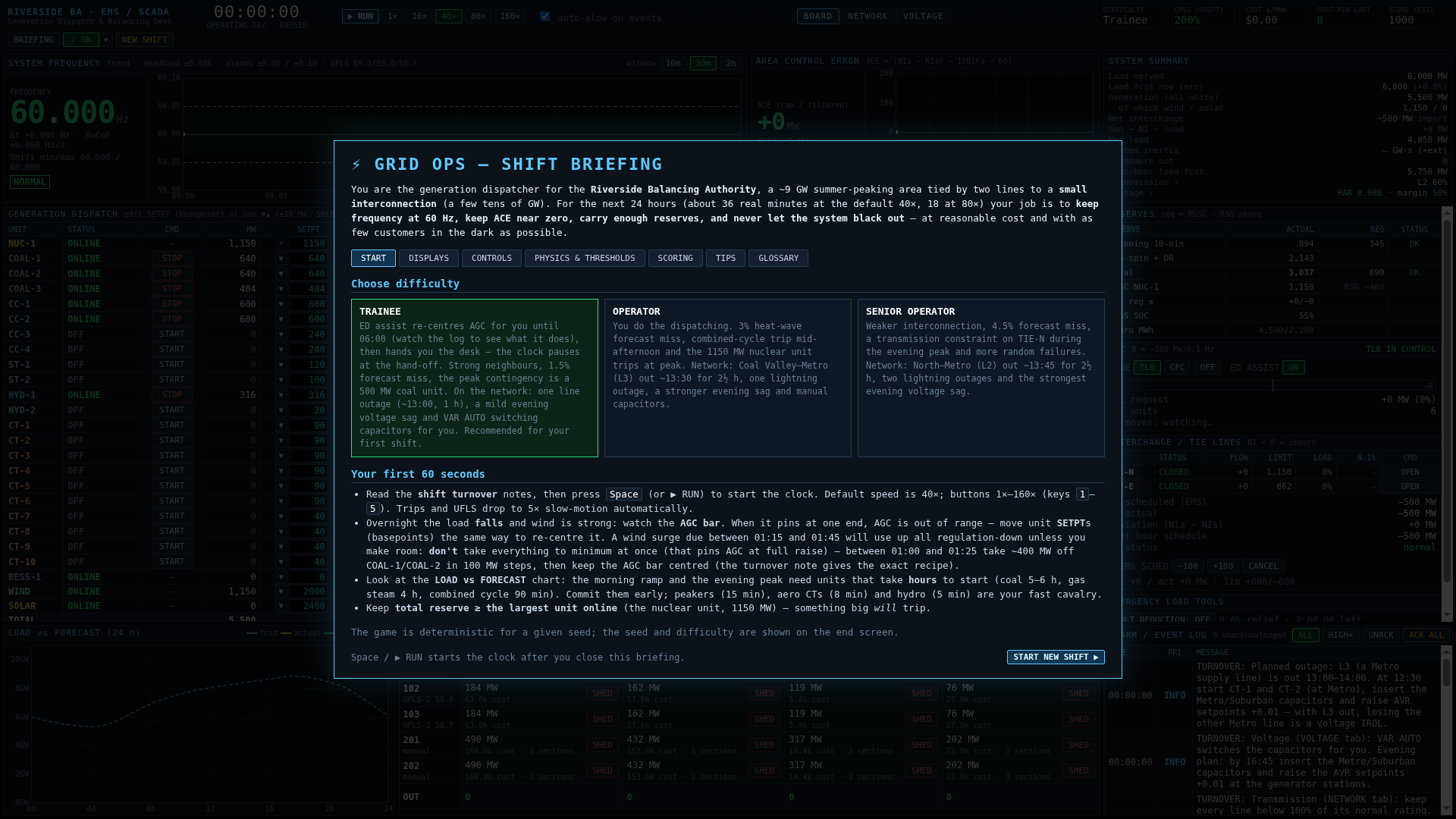
You're the generation dispatcher for Riverside BA, a fictional balancing authority of about 9 GW, and you're working one full 24-hour shift. There are no cartoon power plants and no city building. You get the screens real grid operators use: a spreadsheet-style energy management system (EMS) board, live trend charts, and an alarm log that doesn't stop ringing when things go wrong.
A real control room, not a tycoon game
Every display is modeled on actual EMS/SCADA dispatch screens:
- System frequency and area control error (ACE) trends with AGC status
- Actual load vs. forecast load across the day
- A 25-unit dispatch sheet covering nuclear, coal, combined cycle, gas steam, hydro with reservoirs, frame and aeroderivative peakers, battery storage, wind and solar, with each unit's status, MW, setpoint, limits, ramp rate and headroom
- Spinning and non-spinning reserves
- Tie-line interchange with neighboring systems
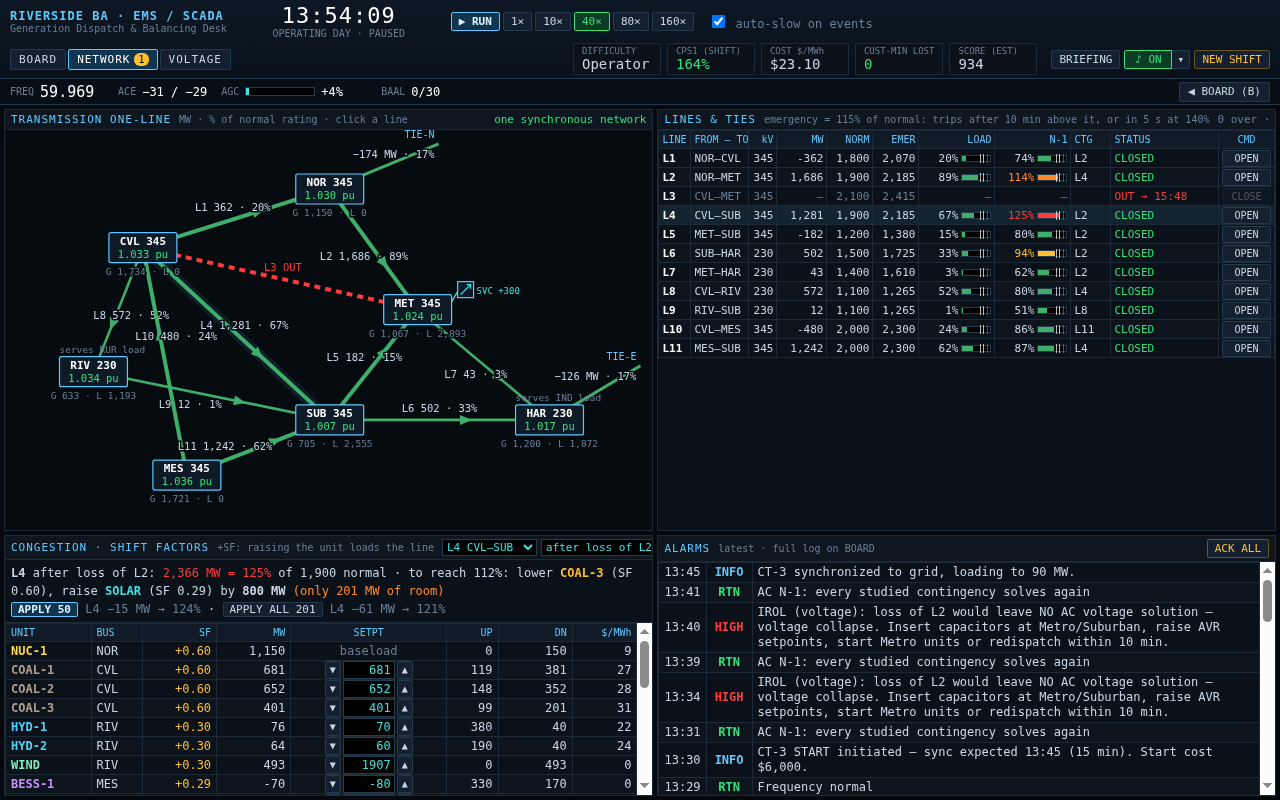
- A NETWORK display with a one-line diagram, line loading against normal and emergency ratings, and live N-1 contingency analysis
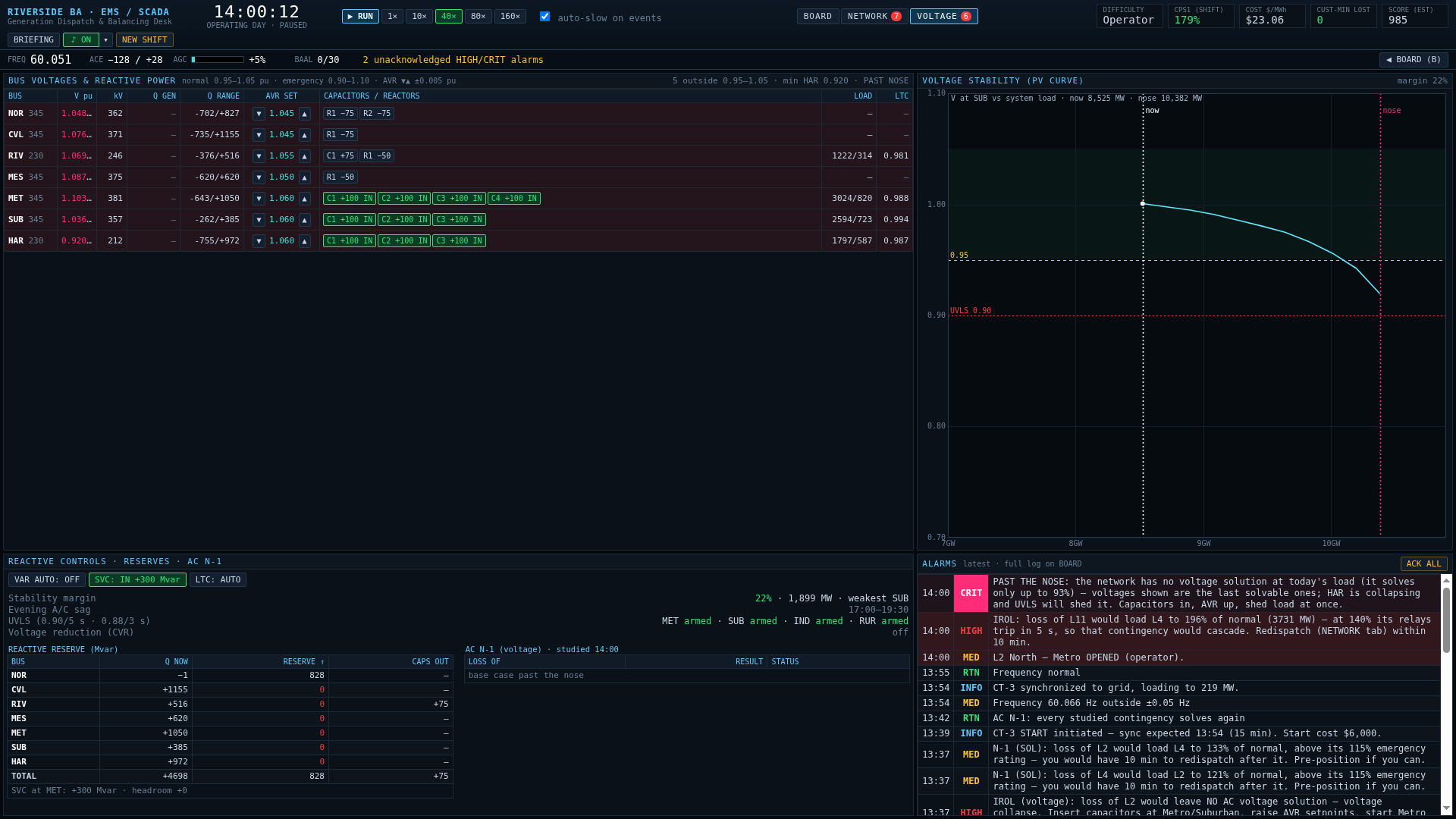
- A VOLTAGE display with bus voltages, reactive reserves, an AC contingency study and voltage stability margin
- A feeder load-shed board covering 4 zones and 20 feeders, plus a prioritized alarm log
Do what real operators do
- Raise and lower unit setpoints within real ramp limits.
- Commit and decommit units, planning around realistic start times. Nuclear and coal take hours, combined cycle less, and peakers and hydro start in minutes.
- Re-dispatch generation to relieve congested lines, using shift-factor advice.
- Manage voltage with capacitors, reactors, generator AVR setpoints, an SVC and tap changers.
- Buy emergency power from neighbors, call demand response, and shed or restore customer load feeder by feeder when there's nothing left.
- Respond to Reliability Coordinator directives and Energy Emergency Alerts (EEA 1–3).
Physics that fights back
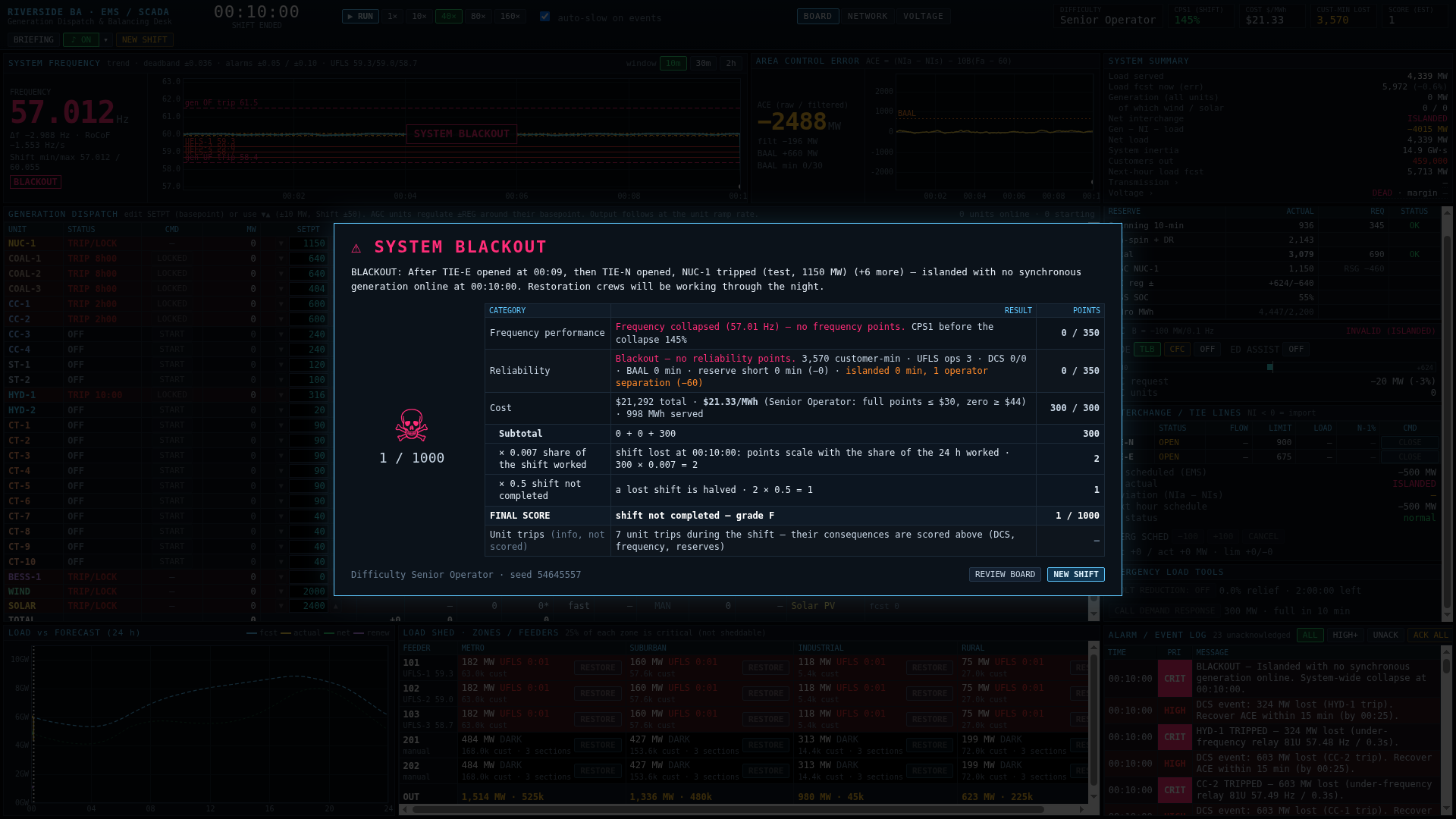
The engine runs a real swing equation with system inertia, governor droop and deadband, and load damping. It runs a DC power flow every tenth of a second and a full AC power flow every game-second. Lose a big unit and you'll watch frequency drop toward its low point within seconds. Below 59.3 Hz, automatic underfrequency load shedding starts tripping your customers. Overloaded lines sag and trip, and flows cascade onto their neighbors. Let voltage slide past the nose of the PV curve and a whole zone collapses. Push it far enough and the entire system goes black.
A shift that gets harder as the day goes on
Scripted and random events build toward the evening peak: wind surges, cloud banks over solar, forecast misses, line outages, neighboring-system trips, an evening voltage sag, and the dreaded nuclear unit trip at peak. Quiet stretches run at high speed, and the game drops into slow motion automatically when an event hits. A full shift takes about 18 minutes of real time at the default speed.
Scored like the real thing
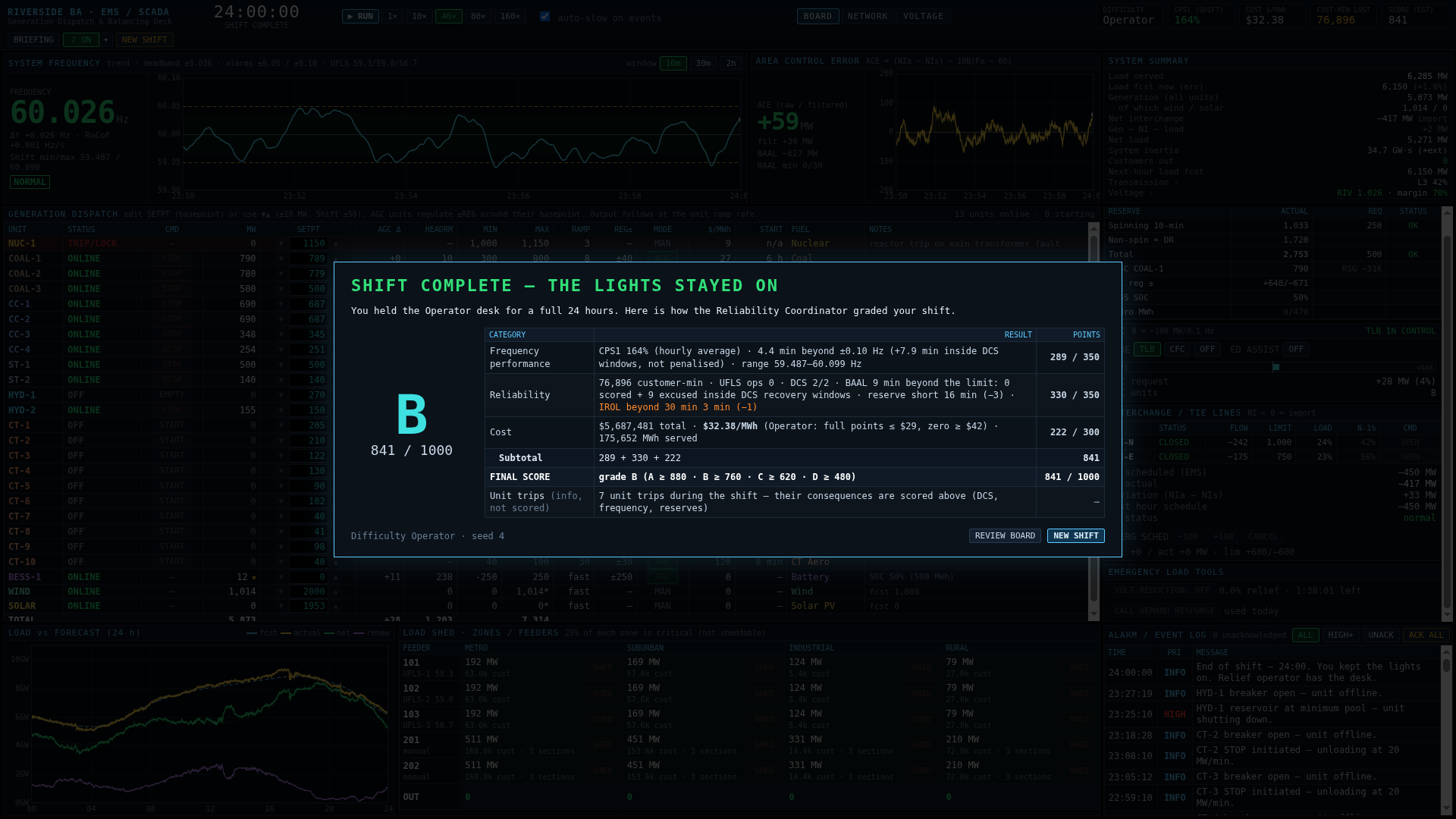
Your shift is graded A to F out of 1000. Frequency performance uses CPS1, BAAL and DCS-style scoring based on NERC standards. Reliability is measured in customer-minutes lost and penalties for limit violations, and economics in dollars per MWh. You end the shift with a win, get relieved of duty, or black out the system, and the end screen shows exactly how your score was calculated.
Three difficulty levels
- Trainee: An economic-dispatch assistant and automatic reactive switching guide you through the night shift, then hand you the controls at 06:00.
- Operator: Less help, more interconnection stress, and a tougher grid.
- Senior: A weak interconnection, no safety nets, and every mistake counts.
Every day is generated from a seed, so you can replay the same shift and beat your score. A shift-turnover note tells you what the last operator expected for the day, but following it to the letter won't save you.
Sound
Ambient control-room music builds into tension and emergency layers as the grid gets into trouble. Alarm tones are tiered by severity, and there are sound effects for breakers, unit trips, capacitor switching, load shedding and more. The music, effects and master volume each have their own slider.
Riverside BA is fictional, and the model is simplified for play. It's a game and training aid, not certified operator training.
Upcoming Features:
- Campaign mode
- Endless high score mode
- Planned maintenance outages
Feedback and bug reports are welcome in the comments. Thank you.
Leave a comment
Log in with itch.io to leave a comment.